Return to Sport Testing
Strength and movement testing to understand your readiness, identify gaps and guide your next steps.
No referral needed to get started in Massachusetts.
100% one-on-one
Full 60-minute sessions
Doctor of Physical Therapy, every visit
Rehab and strength training under one roof
Ready is something you can measure
Feeling ready and being ready aren't always the same thing. Pain can settle weeks before your strength, power, and movement catch up. Return to sport testing shows where you actually stand, so you go back on purpose and not on a hunch.
Pursuit's testing uses strength and movement measures, not only a date on the calendar. It's for athletes coming back from injury or surgery, and for active adults who want to know whether they're ready to run, lift, play or race again.
Why test before you return?
Going back too soon is one of the most common reasons people get hurt again. After an ACL reconstruction, a large study of 106 athletes found that for each month return was delayed, up to nine months, reinjury rates dropped by about 51%. Athletes who passed strict strength and hop-test criteria before returning had far fewer reinjuries than those who didn't. (Grindem et al., British Journal of Sports Medicine, 2016)
That study was about ACL surgery, but the idea carries over. Time matters, and measurements tell you more than time does. Testing also finds weak spots you might not feel, like a leg that's still weaker than the other or a landing that favors one side.
What do we look at?
Your testing depends on your injury and your sport. We commonly look at:
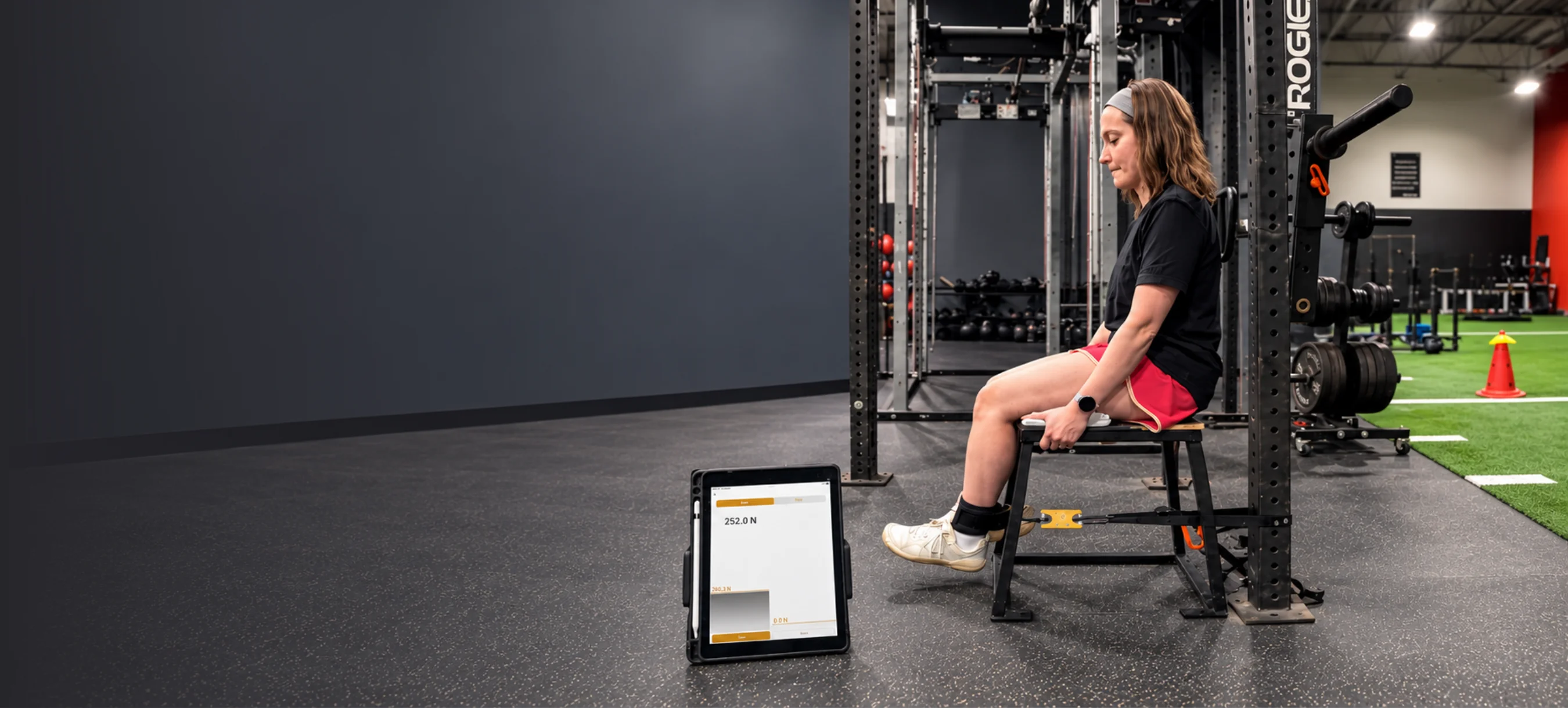
- Strength. How strong the injured side is compared with the other, using objective testing such as dynamometry.
- Hop testing. Single-leg horizontal and vertical hop tests that show how well you can produce and absorb force.
- Movement quality. How you squat, step down, land and cut, and whether one side compensates.
- Balance and control. How steady you are on one leg, with and without a challenge.
- Endurance and conditioning. Whether you can handle the pace and volume of your sport.
- Confidence. How you feel about going back. It counts, and it's measurable too.
If you haven't been tested before, we may start with a movement screen assessment: a quick look at how you squat, lunge, hop and change direction. It's often the first step before the full battery. Gaps found in testing are usually closed with strength and conditioning coaching.
What the results mean
You get a clear picture, not a pass or fail stamp.
- Where you're strong, and what you can already do.
- Where the gaps are, and by how much.
- What to do next: targeted work to close the gaps, a staged return plan or clearance for the next step.
A common benchmark is for the injured side to reach about 90% of the other side on strength and hop tests. It's a guide, not a rule. Some sports and people need more, and numbers are never the whole story.
Who it's for
- Athletes coming back from ACL, meniscus, hip, shoulder or other surgery
- Anyone returning after a sprain, strain or tendon injury
- Runners, lifters, and field and court athletes who want to know before race day or the start of a season
- Parents of young athletes who want a clear answer before the next game
- Active adults who want to know if they can safely return to what they love
Testing can follow rehab at Pursuit or come from elsewhere. If you worked with another clinic and still aren't sure you're ready, we'll test you.
Common situations include ACL rehab physical therapy and meniscus tear physical therapy, rotator cuff surgery rehab, hip impingement (FAI) treatment, ankle sprain rehab, Achilles tendonitis physical therapy and knee pain physical therapy after a layoff. Sports physical therapy and youth sports physical therapy patients get testing before the next season starts.
How does it work?
- Understand your starting point. We review your injury, your surgeon's or provider's guidance and your sport.
- Build the capacity to move forward. Testing happens one-on-one, with time to explain what we see and how to improve it.
- Get back to what matters. You get a plan: gaps to close, a staged return or clearance for the next step.
Testing is a natural next step after ACL and post-surgical rehab or sports physical therapy. Many athletes then continue with strength and performance training to build on what the numbers show.
A note on medical clearance
We test movement and strength. We don't replace your surgeon or doctor. If you've had surgery or a significant injury, we'll work with their guidance and keep them informed with your permission.
Your physical therapist
Testing is done by Dr. Tarandeep (TJ) Jaidka, a doctor of physical therapy, in a one-on-one session.
Return to sport testing near Hopedale
We're at 3b Condon Way in Hopedale, MA, serving athletes from Milford, Franklin, Hopkinton and across the Blackstone Valley. Monday through Saturday, by appointment.
If you're searching for physical therapy near your location, or a physical therapist near you who tests before clearing you, Pursuit is in Hopedale and open Monday through Saturday by appointment.
Take the next step toward your goals.
Tell us about your injury, your sport and what you're aiming to get back to.
- Book an appointment. Tell us what you'd like to get back to.
- Pick a time. Then we'll get started.
Move better. Perform stronger. Pursue more.
Frequently asked questions
What is the return to sport testing?
A set of strength, hop, movement and balance tests that shows whether you're ready to return to your sport after injury or surgery, and where the gaps are.
When should I do return to sport testing?
Usually once pain and swelling are controlled, motion is restored and you've built a base of strength. After surgery, timing depends on your surgeon's protocol.
What if I don't pass?
That's useful information. We'll show you where the gaps are and build a plan to close them, then retest.
Can testing guarantee I won't get hurt again?
No. Testing lowers the chance of going back too soon, but no test can promise you won't be reinjured.
Do I need a referral?
No. Massachusetts allows you to see a physical therapist directly. After surgery, we'll coordinate with your surgeon.