Hip and Groin Pain in Hockey Players: What to Do About It
Key pointers
- Short answer: hockey groin pain is usually a strength and load problem driven by the skating stride. Good hip pain physical therapy finds which structure is involved, then rebuilds it under load, in-season when possible.
- The stride is the mechanism. Thousands of push-offs from a deep crouch load the adductors, hip flexors and front of the hip, usually more on one side.
- It’s rarely just “a pulled groin.” Adductor strains, hip flexor strains, athletic pubalgia and hip impingement all hurt there and need different plans.
- Stretching and waiting for spring both fail. One treats a strength problem with length. The other lets the hip get weaker while the pain fades.
- At Pursuit, every visit is 60 minutes one-on-one with Dr. TJ, in a gym with sleds, racks and room to rebuild a skating stride.
- No referral needed in Massachusetts; Pursuit is out-of-network and provides superbills.
You push off hard on a crossover and feel a pull deep in your groin. You finish practice anyway. The next morning, getting out of the car hurts more than the skate did.
So you stretch it before every practice, play through it and tell yourself the off-season will fix it. Then the first skate in September brings it right back. That’s what happens when a loading problem gets treated like a tightness problem.
Here’s what the stride does to the hip, how to tell the diagnoses apart, and what hip pain physical therapy looks like for a player who wants to keep skating.
Why the skating stride beats up the hip
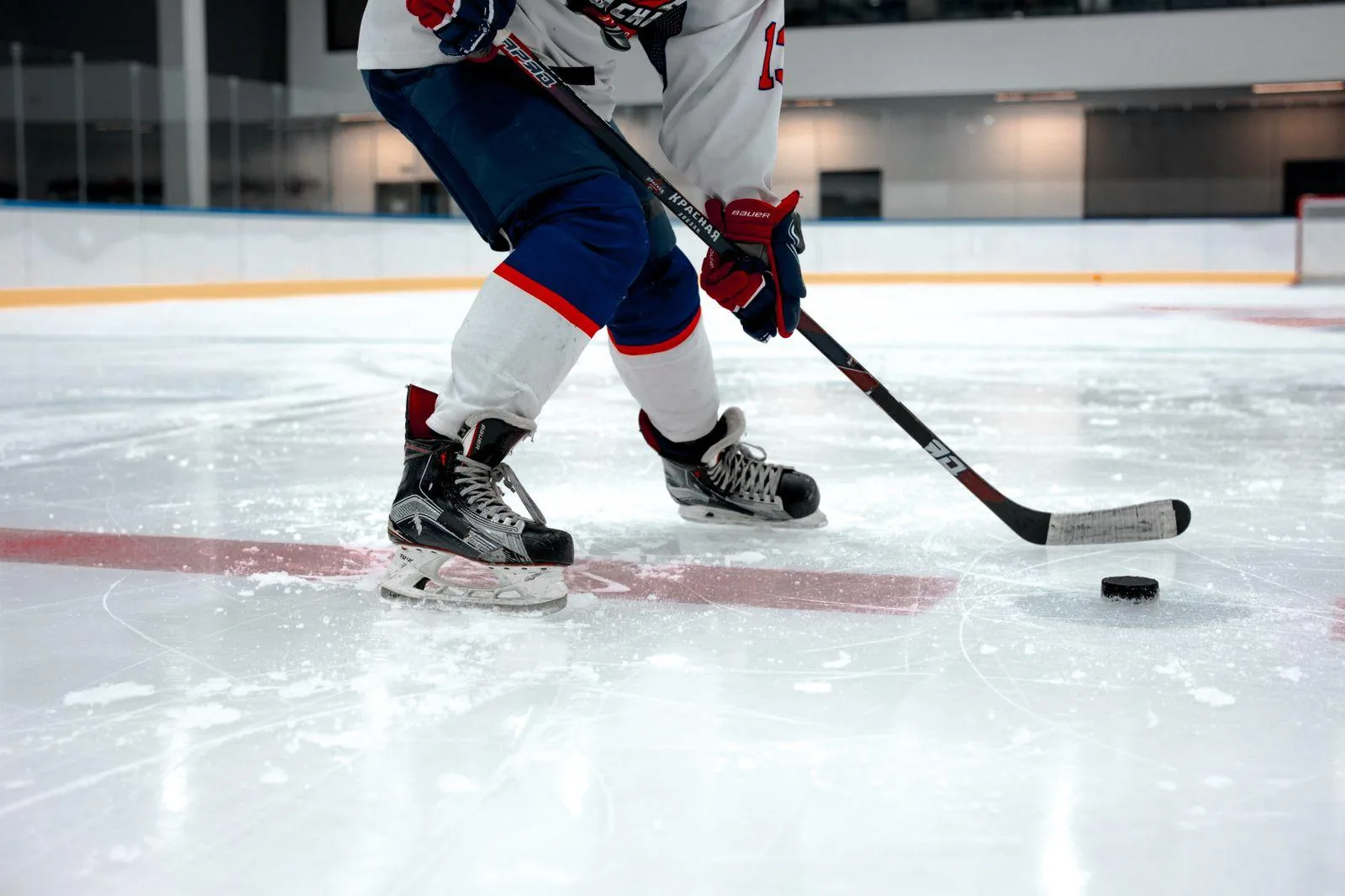
A stride is hip extension, abduction and external rotation on the push, then flexion and adduction to recover the leg. You do it from a deep crouch, thousands of times a week.
- The adductors work in both directions. They lengthen under load on the push, then shorten hard to pull the leg back. That cycle is where most groin strains happen.
- The deep crouch loads the front of the hip. The hip flexors work shortened all shift, and the front of the joint is compressed every time the knee drives through.
- The load is one-sided. Your push leg, shooting side and preferred crossover direction stack load unevenly. Over a season, one hip does more.
Research has repeatedly found impingement-type bony changes in hockey players’ hips, including players with no pain. An imaging finding alone doesn’t tell you what’s hurting.
Why “stretch it” and “rest until spring” both fail
1. Stretching treats a strength problem with length. Most hockey groin pain comes from adductors or hip flexors that can’t handle the demand, not muscles that are too short. If the problem is impingement, deep stretches push straight into the pinch.
2. Rest lets the pain fade while the hip gets weaker. Four months off the ice calms the tissue and strips strength and conditioning. Your first skate back asks a weaker hip to do the same job.
3. The wrong diagnosis gets treated. An adductor strain and athletic pubalgia often exist together. A hip flexor strain can sit on top of impingement. Treat half, and the other half keeps hurting.
4. The core work is the wrong core work. Sit-ups pull on the pubic region that’s already overloaded. The hip needs a trunk that stays stiff while the legs drive.
How to tell what’s actually hurting
| Where it hurts | What it usually is | What makes it worse | First move |
|---|---|---|---|
| Inner thigh, up toward the pubic bone | Adductor strain | Push-off, crossovers, squeezing the knees together | Adductor squeeze holds, then Copenhagen plank progressions |
| Front of the hip, into the upper thigh | Hip flexor strain (iliopsoas or rectus femoris) | Knee drive, sprinting, recovering the leg | Isometric hip flexion holds, then loaded marches |
| Low abdomen and groin | Athletic pubalgia (“sports hernia”) | Sit-ups, sneezing, cutting, hard shots | Adductor and trunk strength together; a surgical opinion if months of loading don’t help |
| Deep in the groin, a pinch in deep flexion | Femoroacetabular impingement (FAI) with labral irritation | Deep squats, long sitting, the low crouch, pivoting | Modify depth, build rotation control and glute strength |
“Sports hernia” is a misleading name. There’s usually no hernia. It’s a strain where the lower abdominals and adductors meet at the pubic bone, treated as a loading problem first.
What hip pain physical therapy looks like for hockey players
- Adductor strength, loaded and progressed. Adductor squeezes against a ball, then Copenhagen planks: short lever first, then long lever, then more time. Research consistently links adductor strength to fewer groin injuries.
- Hip flexor strength, not just stretches. Banded marches, hanging knee raises and resisted hip flexion build the muscle that drives every stride.
- Hip rotation control. Glute strength and controlled rotation under load keep the joint out of the pinch on every push.
- Trunk strength that matches the stride. Pallof presses, suitcase carries and side planks teach the trunk to stay stiff while the legs work.
- Off-ice load management. Count skates, games and off-ice sessions per week. Pain usually shows up when all three climb at once.
- A return-to-skate progression. Straight-line skating, then crossovers, then stops and starts, then full speed, then contact. You move up when the last step doesn’t flare the next morning. Return-to-sport testing comes before full speed.
Managing it in-season
Most hockey players don’t need to stop skating. They need the load organized. Cut practice volume before games. Skip the drills that provoke it, often crossovers toward the bad side. Do strength work on fixed days, not the night before a game.
Pain that settles within 24 hours is acceptable. Pain that’s worse the next day means the dose was wrong. If a guarded adductor is limiting you, dry needling can take the edge off.
How Pursuit treats hip and groin pain in hockey players
Every visit at Pursuit PT & Performance in Hopedale is a full 60 minutes with Dr. Tarandeep Jaidka (TJ). For a hockey hip, the hour is used like this:
- Sort out which structure it is. Adductor, hip flexor, pubic region and hip joint are tested separately, because they’re treated differently.
- Measure the gaps. Adductor squeeze strength, hip rotation range, single-leg control and trunk endurance, side to side. Nothing is guessed.
- Load it in a real gym. Copenhagen progressions, sleds and barbells are the core of strength and performance training built into your rehab.
- Make the loading tolerable. Manual therapy and dry needling for a guarded adductor take the edge off so you can train. They support the plan; they aren’t the plan.
- Test before you go full speed. Return-to-sport testing checks adductor strength, single-leg power and change of direction before you’re cleared.
Youth, high school and men’s league players can start with sports physical therapy.
When to see a physical therapist, a doctor or a surgeon
- Groin or hip pain lasting more than 2–3 weeks, or that has come back more than once
- Pain that eases during a skate and returns the next morning
- Pain with sit-ups, coughing or sneezing, which points toward the pubic region
- Catching, locking or a deep pinch unchanged after 2–3 months of proper loading. That’s when imaging and a hip specialist make sense.
- A sudden, severe pull with bruising or an inability to bear weight. In younger players, a bony avulsion needs to be ruled out promptly.
- Numbness, fever or pain unrelated to activity, which need a physician first
Frequently asked questions
Should I keep skating with groin pain?
Usually yes, with the load adjusted. Most players rehab in-season by cutting provoking drills and practice volume. A full stop is reserved for acute strains.
Is my groin pain a sports hernia?
Possibly, but adductor and hip flexor strains are more common and hurt in a similar spot. Pain with sit-ups, coughing and shooting raises the suspicion. Either way, treatment starts with progressive loading.
How long does hockey groin pain take to heal?
A simple adductor strain often settles in a few weeks of proper loading. Pubic-region and impingement-related pain typically take 2–3 months or more.
Do I need a referral in Massachusetts?
No. Massachusetts allows direct access, so you can book with us directly. Learn more in do you need a referral to see a physical therapist in Massachusetts.
Do you take insurance?
We’re out-of-network. We provide superbills you can submit to your insurer.
Where are you located?
We’re at 3b Condon Way, Hopedale, MA. Patients come from Milford, Franklin, Hopkinton, Holliston, Medway and across the MetroWest and Greater Boston area.
Fix the stride, not just the groin.
If your hip has been through the stretch, skate, rest cycle more than once, something was never rebuilt. Book a full hour with TJ and leave knowing what’s hurt, what’s weak and how you get back on the ice.
Book an appointment, no referral needed.